
Affiliate marketing is often promoted as one of the easiest ways to make money online.
In one sense, that is true.
You don’t need to manufacture a product, hold stock, deal with deliveries or provide customer service. You can start with relatively little money, and you can promote products created by established businesses rather than having to invent something yourself.
But there is an important catch.
Affiliate marketing is simple to understand, but it isn’t necessarily easy to succeed at.
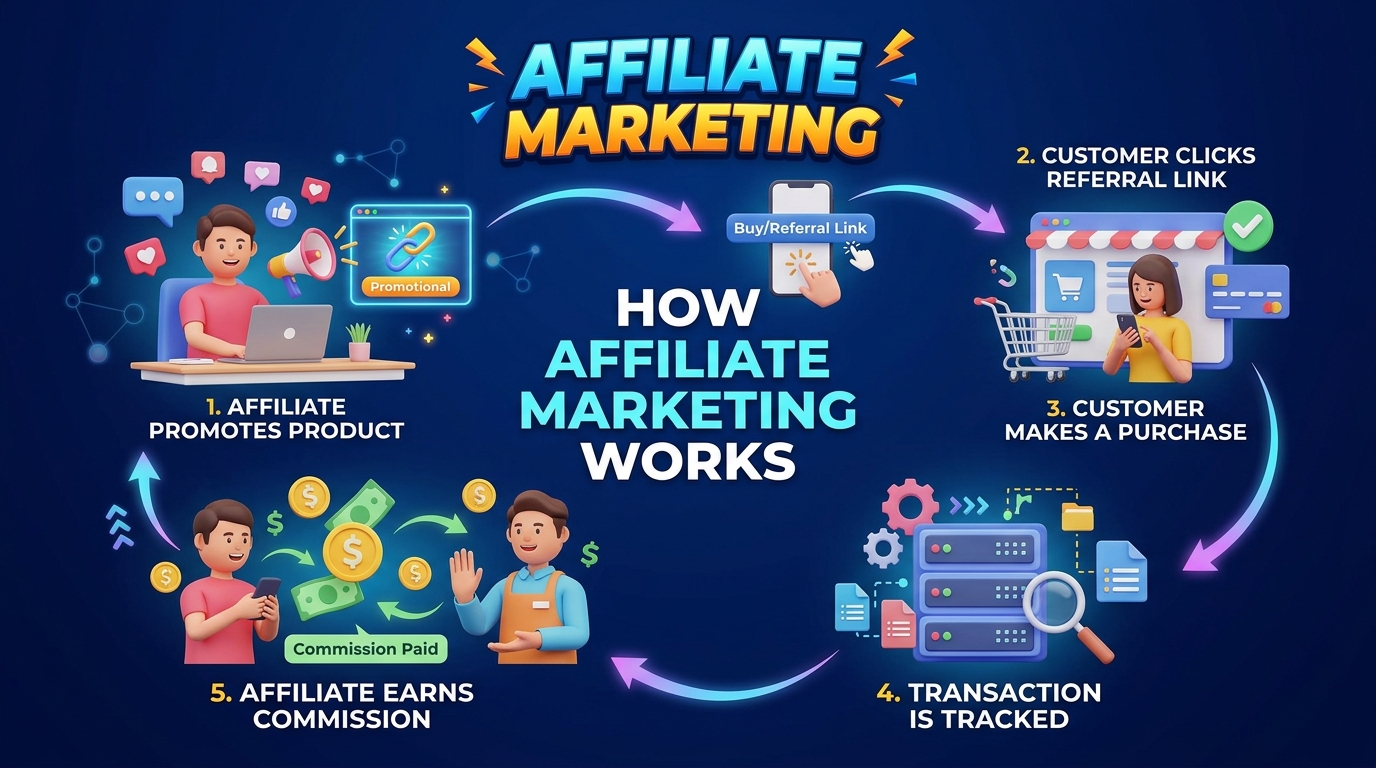
The basic idea can be explained in a few sentences: you recommend somebody else’s product or service, somebody follows your special affiliate link, they make a purchase, and you receive a commission.
The difficult part is everything that happens before that click.
You need to find the right market, choose useful products, build an audience, create content that people actually want to consume, earn their trust and get your content in front of potential buyers.
That is why affiliate marketing should be viewed as a business model, rather than a quick-money scheme.
In this guide, I’ll explain exactly how affiliate marketing works, the different ways you can promote products, the biggest challenges beginners face, the steps involved in building an affiliate business and, perhaps most importantly, how long you should realistically expect to wait before seeing results.
What Is Affiliate Marketing?
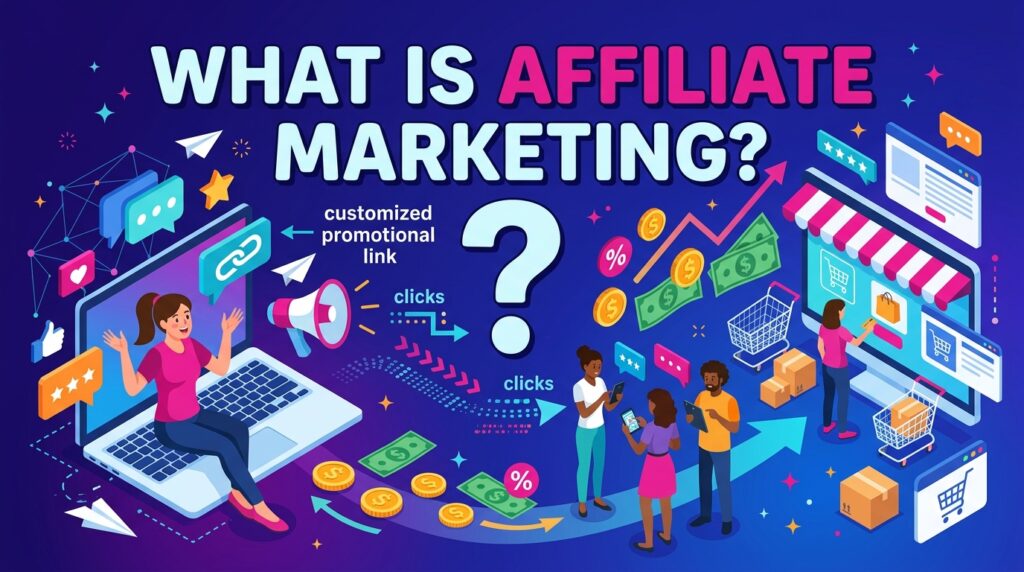
Affiliate marketing is a performance-based marketing model where a business pays a commission to someone who generates a sale, lead or other desired action.
There are usually three main parties involved:
- The merchant – the company selling the product or service.
- The affiliate – the person promoting the product.
- The customer – the person who eventually buys the product.
There is also usually a fourth party behind the scenes:
- The affiliate network or platform – the system that tracks referrals and commissions.
For example, imagine you have a website about home offices.
You write an article called:
“10 Best Office Chairs For Working From Home.”
Within the article, you recommend several chairs and include your affiliate links.
A reader clicks your link and visits the retailer’s website.
If they subsequently purchase the chair, the retailer records that the customer came through your affiliate link.
You then receive your agreed commission.
The customer doesn’t normally pay extra simply because they used your affiliate link.
The merchant is effectively rewarding you for helping generate the sale.
How Does Affiliate Marketing Actually Work?
The process looks complicated when you first encounter tracking links, affiliate networks, cookies, commissions and payment thresholds.
But the basic process is surprisingly straightforward.
Step 1: You join an affiliate programme
A company allows you to become an affiliate.
This might be directly through the company’s own affiliate programme or through an affiliate network.
You receive access to your affiliate dashboard and unique tracking links.
Step 2: You choose products to promote
You select products or services that are relevant to your audience.
For example:
- Web hosting
- Software
- Online courses
- Home bar equipment
- Beer accessories
- Office equipment
- Website builders
- AI tools
- Business services
The best affiliate products aren’t necessarily the ones paying the highest commission.
They are the products that solve a genuine problem for your audience.
Step 3: You create useful content
This is where the real work begins.
You might create:
- Blog posts
- Product reviews
- Comparison articles
- YouTube videos
- Tutorials
- Social media posts
- Pinterest content
- Email newsletters
- Buying guides
- Case studies
The content attracts people who are interested in the subject.
Step 4: You place affiliate links within the content
You naturally introduce relevant products.
For example:
“If you’re looking for a compact office chair for a small workspace, this model is worth considering because…”
The product name or button can then contain your affiliate link.
Step 5: Someone clicks your link
The affiliate tracking system records the referral.
Depending on the programme, tracking may involve cookies or other attribution technology.
Step 6: The customer completes the required action
This might be:
- Buying a product
- Signing up for a service
- Starting a free trial
- Completing a form
- Opening an account
- Subscribing to software
Step 7: The affiliate receives a commission
If the transaction qualifies under the programme’s rules, the commission is recorded in your affiliate account.
Eventually, once any required holding or validation period has passed and you’ve reached the payment threshold, you receive your money.
A Simple Affiliate Marketing Example
Let’s make this more concrete.
Imagine you have a website about starting an online business.
You write an article:
“The 7 Best Website Hosting Services For Beginners.”
You recommend five hosting companies.
One of those companies pays you £50 for every qualifying customer you refer.
Suppose 1,000 people visit your article.
Perhaps 50 click through to the hosting company.
If five of those visitors become customers, you have generated:
5 × £50 = £250
That’s affiliate marketing in its simplest form.
But notice something important.
You didn’t get paid because you wrote an article.
You didn’t get paid because 1,000 people visited your website.
You got paid because your content helped generate qualifying customers.
That distinction is extremely important.
The Affiliate Marketing Funnel
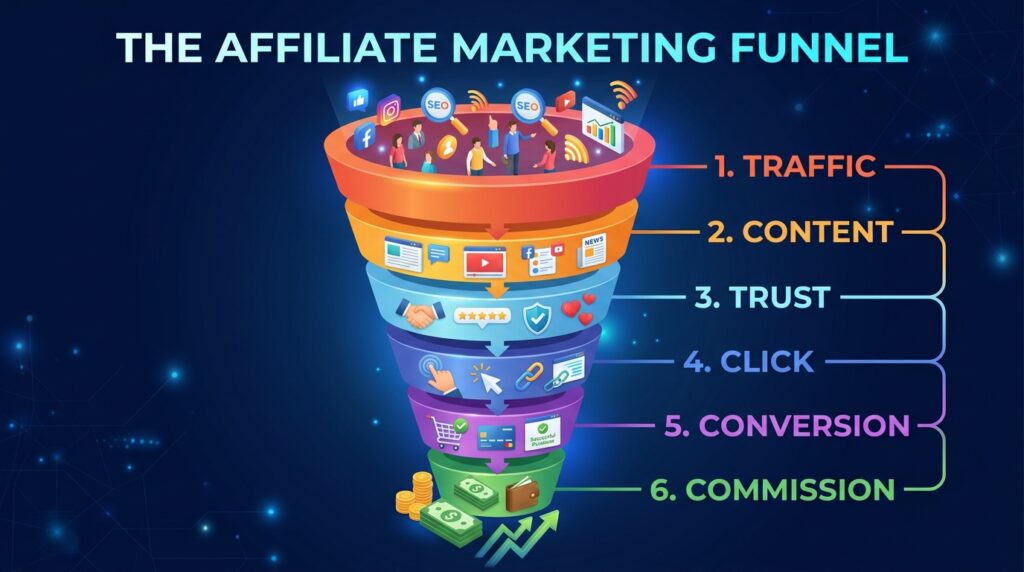
Successful affiliate marketing is essentially about moving people through a funnel.
Traffic → Content → Trust → Click → Conversion → Commission
Let’s break that down.
Traffic
People need to find your content.
Traffic can come from:
- YouTube
- TikTok
- X
- Paid advertising
Content
Your content needs to answer a question, solve a problem or help someone make a decision.
Trust
People are much more likely to buy something when they trust the person recommending it.
This is why simply throwing affiliate links into articles rarely works well.
Click
The visitor decides that the product you’ve recommended is worth investigating.
Conversion
The visitor purchases or completes the required action.
Commission
The affiliate programme credits you with the sale.
The biggest mistake beginners make is concentrating almost entirely on the commission.
Successful affiliates concentrate on improving every stage of the funnel.
Where Can You Do Affiliate Marketing?
One of the advantages of affiliate marketing is that you aren’t restricted to having a traditional website.
There are several possible platforms.
Affiliate Marketing With A Website
A website remains one of the strongest foundations for affiliate marketing.
You can build content around specific search queries and create a library of articles that continue attracting visitors.
For example:
- Best laptops for students
- Best website hosting for beginners
- How to start a blog
- Best email marketing software
- Best AI tools for small businesses
The advantage is that you own the website and the content.
You aren’t completely dependent on one social media platform.
Affiliate Marketing With YouTube
YouTube can be particularly powerful for affiliate marketing because people often watch videos when they are researching products.
You could create:
- Product reviews
- Tutorials
- Comparisons
- “Best X” videos
- Demonstrations
- Unboxing videos
- How-to guides
A video demonstrating how a product works can sometimes be considerably more persuasive than a written description.
Affiliate Marketing With Pinterest
Pinterest can work particularly well for visually appealing niches.
Examples include:
- Home improvement
- Home bars
- DIY
- Fashion
- Recipes
- Travel
- Home offices
- Crafts
- Gardening
A Pinterest pin can send someone to a detailed article containing your affiliate recommendations.
This creates a useful path:
Pinterest → Website → Product recommendation → Affiliate click → Sale
Affiliate Marketing With Social Media
Platforms such as Facebook, Instagram, TikTok and X can also be used.
However, social media requires a slightly different approach.
People don’t necessarily visit social platforms specifically intending to buy something.
Your job is often to first attract attention and build an audience.
Then you can introduce products that genuinely fit their interests.
The Biggest Mistake Beginners Make
One of the most common mistakes is thinking:
“I’ll find some products with good commissions and then promote them.”
This puts the product before the audience.
A better approach is:
Find an audience → understand their problems → create useful content → recommend relevant products.
For example, don’t start with:
“What product can I promote?”
Start with:
“What problem does my audience have?”
Then ask:
“What products or services genuinely solve that problem?”
That small change in thinking can make a huge difference.
The Biggest Challenges Affiliate Marketing Beginners Face

Affiliate marketing is relatively easy to start.
That doesn’t mean it is easy to build into a profitable business.
Here are some of the biggest challenges you’ll face.
Challenge 1: Choosing A Niche
Many beginners struggle to decide what they should build their business around.
They worry that they need to find the “perfect” niche.
You don’t.
Instead, look for an area where three things overlap:
Interest + Demand + Monetisation
You want something people are interested in, something people actively search for or consume content about, and something where suitable products or services exist.
How to overcome it
Ask yourself:
- What do I know about?
- What am I interested in learning more about?
- What problems do people have in this area?
- Are people spending money in this market?
- Are there affiliate programmes available?
- Can I create dozens or potentially hundreds of useful pieces of content?
Don’t choose a niche simply because somebody claims it is profitable.
Choose something you can realistically stick with.
Challenge 2: Getting Traffic
This is probably the biggest obstacle for beginners.
You can create an excellent article.
You can select great affiliate products.
You can write persuasive recommendations.
But if nobody sees your content, you won’t make sales.
How to overcome it
Choose one or two traffic strategies and learn them properly.
For example:
Website + SEO
or
Website + Pinterest
or
YouTube + SEO
rather than trying to master six platforms simultaneously.
Traffic is an asset that you build over time.
Challenge 3: Getting Your First Sale
Your first affiliate commission can feel like a huge milestone.
But many beginners become discouraged because they don’t get a sale immediately.
This is normal.
You may need:
- More visitors
- Better content
- Better product selection
- Better calls to action
- Higher buyer intent
- More trust
- Better search rankings
How to overcome it
Don’t judge your entire business by the first few weeks.
Instead, measure smaller milestones.
For example:
First article published
→ First visitor
→ First affiliate click
→ First email subscriber
→ First sale
→ First £10
→ First £100
These milestones tell you that the system is beginning to work.
Challenge 4: Building Trust
People are increasingly cautious about online recommendations.
If every article says:
“This is the BEST product!”
readers quickly stop believing you.
How to overcome it
Be honest.
Discuss:
- Advantages
- Disadvantages
- Who the product is suitable for
- Who should avoid it
- Important features
- Alternatives
- Price considerations
- Your own experience where applicable
You don’t have to pretend every product is perfect.
In fact, explaining the drawbacks can make your recommendations more believable.
Challenge 5: Information Overload
A beginner can easily become overwhelmed.
SEO.
Pinterest.
YouTube.
Email marketing.
Affiliate networks.
Keyword research.
AI.
Website design.
Social media.
Analytics.
It can feel like you need to learn everything before you can begin.
You don’t.
How to overcome it
Learn in the order that matters.
I’d recommend:
Choose a niche
↓
Build your platform
↓
Research your audience
↓
Create useful content
↓
Learn one traffic source
↓
Add affiliate products
↓
Build an email list
↓
Analyse results
↓
Improve what works
You can learn everything else as you need it.
Challenge 6: Choosing The Wrong Affiliate Products
A high commission doesn’t automatically make a product good.
Imagine two products.
Product A pays £100 commission but is difficult to sell.
Product B pays £15 commission but is highly relevant to your audience and converts well.
Product B could ultimately make you much more money.
How to overcome it
Consider:
- Relevance
- Product quality
- Brand reputation
- Commission
- Conversion rate, where available
- Cookie/attribution period
- Recurring commissions
- Customer demand
- Price
- Refund rates
- Your own confidence in recommending it
Trust and relevance should come before commission percentage.
Challenge 7: Giving Up Too Early
This is perhaps the biggest problem of all.
Someone starts a website.
They publish ten articles.
Nothing happens.
They publish another five.
Still very little traffic.
They conclude:
“Affiliate marketing doesn’t work.”
Often the problem isn’t the business model.
They simply stopped before they had given the business enough time to develop.
How Long Does Affiliate Marketing Take To Make Money?
This is one of the most important questions beginners ask.
There is no guaranteed timeline.
Anyone promising:
“You’ll make £1,000 within 30 days”
should be treated with extreme caution.
Affiliate marketing results vary enormously depending on:
- Niche
- Competition
- Content quality
- Traffic source
- Publishing frequency
- SEO ability
- Audience size
- Product selection
- Conversion rate
- Existing audience
- Marketing experience
However, a realistic general timeline looks something like this.
Months 1–3: Foundation
You are primarily building.
You might:
- Choose your niche
- Build your website
- Join affiliate programmes
- Publish your first articles
- Create social profiles
- Start building an email list
- Learn SEO
- Start generating your first visitors
Income may be £0 or very small.
That doesn’t mean the business isn’t working.
Months 3–6: Early Traffic
You should start seeing more evidence that your content is gaining traction.
Some articles may begin ranking.
You may receive:
- More organic traffic
- Affiliate clicks
- Your first commissions
- Social traffic
- Email subscribers
Some people will make their first money during this period.
Others won’t.
Both are normal.
Months 6–12: Momentum
This is where a well-executed affiliate website can begin becoming more interesting.
You now have a larger content library.
Some pages may rank well.
You have more data.
You can identify:
- Which articles attract traffic
- Which products receive clicks
- Which pages convert
- Which traffic sources work
- Which topics deserve more content
You can then double down on what works.
12–24 Months: Building A Real Business
If you’ve consistently produced useful content and developed reliable traffic sources, this is where the compounding effect can become powerful.
You have potentially built:
- Hundreds of pieces of content
- Search traffic
- Pinterest traffic
- YouTube videos
- An email list
- Social followers
- Affiliate relationships
- Brand recognition
- Historical data
At this point, you’re no longer starting from zero every month.
Your previous work can continue producing visitors and sales while you create new content.
The Affiliate Marketing Compounding Effect
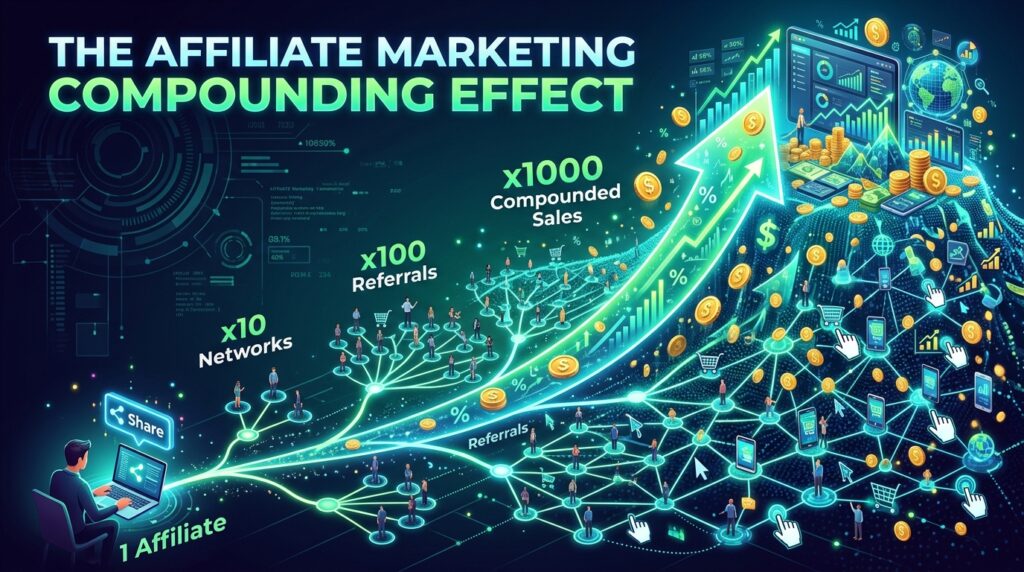
This is one of the most attractive aspects of content-based affiliate marketing.
Imagine you publish one useful article every week.
After one year, you’ve created roughly:
52 articles.
After two years:
104 articles.
Not every article will become successful.
But some may generate traffic every month.
Those successful articles can then be improved and expanded.
You can create related articles around them.
You can link those articles together.
You can create Pinterest pins and YouTube videos from them.
You can promote them through email.
One piece of research can therefore turn into multiple pieces of content.
This is how an affiliate content business can gradually become much larger than it initially appears.
The Steps To Succeed With Affiliate Marketing
So what should a beginner actually do?
Here’s the process I’d recommend.
Step 1: Choose A Niche
Choose a market where you can realistically create useful content.
Don’t obsess over finding a completely untouched niche.
Instead, look for a specific audience with specific problems.
Step 2: Research Your Audience
Find out what your audience wants.
Look at:
- Google searches
- YouTube searches
- Forums
- Facebook groups
- Product reviews
- Amazon reviews
- Competitor websites
Pay particular attention to the questions people repeatedly ask.
Those questions can become content ideas.
Step 3: Research Affiliate Programmes
Find products and services that genuinely fit your audience.
Potential sources include:
- Individual company affiliate programmes
- Affiliate networks
- Retailer affiliate programmes
- Software affiliate programmes
- Digital product programmes
Don’t join dozens of programmes immediately.
Start with a small number of relevant products.
Step 4: Build Your Platform
For many beginners, a website is a strong foundation because you have more control over it than you do over a social media account.
You can then use other platforms to bring people to your website.
For example:
Website + Pinterest + YouTube + Email
can form a powerful combination.
Step 5: Create Helpful Content
Don’t create content purely because you want somewhere to put an affiliate link.
Create content because it helps somebody.
Some excellent affiliate content formats include:
“Best” articles
10 Best Laptops For Working From Home
Comparison articles
Product A vs Product B: Which Is Better?
Reviews
Product A Review: Is It Worth Buying?
Problem-solving articles
How To Improve Your Home Wi-Fi
Tutorials
How To Start A Website From Scratch
Buying guides
What To Look For When Buying A Laptop
These types of articles can naturally lead into product recommendations.
Step 6: Learn Buyer Intent
Not all visitors are equally valuable.
Someone searching:
“What is a laptop?”
is probably at the research stage.
Someone searching:
“Best laptop for working from home under £700”
has much stronger buying intent.
This doesn’t mean you should only create commercial content.
You need a mixture.
But you should understand where your visitors are in the buying journey.
A simple funnel might look like:
Awareness
“What is affiliate marketing?”
↓
Research
“How does affiliate marketing work?”
↓
Comparison
“Best affiliate marketing platforms”
↓
Buying decision
“Best affiliate marketing course”
The closer someone gets to a purchasing decision, the more commercially valuable the visitor can become.
Step 7: Add Affiliate Links Naturally
Don’t plaster affiliate links everywhere.
Place them where they genuinely help the reader.
For example, after explaining why a particular product is suitable, you might provide a:
Check Price / Learn More
button.
You should also make your affiliate relationship clear through appropriate disclosure.
Transparency helps protect your reputation and can be required by applicable advertising and consumer-protection rules.
Step 8: Build An Email List
Don’t rely entirely on search engines or social media.
Those platforms can change their algorithms.
An email list gives you a direct communication channel with people who have chosen to hear from you.
You could offer something useful in exchange for an email address.
For example:
Free Online Business Starter Checklist
A new subscriber might then receive a helpful sequence of emails introducing them to:
- Starting an online business
- Choosing a niche
- Building a website
- Creating content
- Affiliate marketing
- Useful tools
Eventually, relevant affiliate recommendations can become part of that relationship.
Step 9: Learn SEO
SEO can be extremely valuable for affiliate marketers because it can bring people to your content while they are actively searching for information.
Learn the fundamentals:
- Keyword research
- Search intent
- Helpful content
- Internal linking
- Page titles
- Headings
- Meta descriptions
- Site structure
- Technical SEO
- External links
- Updating older content
You don’t need to become an SEO expert before publishing your first article.
Learn as you go.
Step 10: Diversify Your Traffic
Once your website is established, don’t depend entirely on Google.
You can develop additional traffic sources such as:
- YouTube
- TikTok
- X
The aim isn’t to become an expert on every platform.
Instead, find the platforms where your audience spends time.
Step 11: Track Your Numbers
One of the great advantages of affiliate marketing is that you can measure what is happening.
Track things such as:
- Website visitors
- Page views
- Affiliate clicks
- Click-through rate
- Conversions
- Commission
- Revenue per article
- Revenue per visitor
Suppose one article gets 10,000 visitors but generates £20.
Another gets 1,000 visitors but generates £150.
Which article is more valuable?
The answer is obvious.
Traffic isn’t the only metric that matters.
Step 12: Improve What Works
Once you have data, stop guessing.
If a particular article generates lots of affiliate clicks, improve it.
You might:
- Add better product comparisons
- Improve the introduction
- Add FAQs
- Add clearer calls to action
- Add additional products
- Improve internal links
- Update outdated information
- Create supporting articles
If a topic performs well, create more content around that topic.
This is how you turn a collection of articles into a business.
What Does A Successful Affiliate Website Look Like?
A successful affiliate website isn’t simply a collection of product links.
It is more like a helpful resource centre.
Imagine a website about home offices.
It might contain:
Pillar guide
→ How To Create The Perfect Home Office
Supporting content
→ Best Office Chairs
→ Best Desks
→ Best Desk Lamps
→ How High Should A Desk Be?
→ How To Improve Home Office Lighting
→ Best Monitors
→ Best Budget Laptops
Each article can link to other relevant articles.
The reader gets useful information.
The website owner gets more opportunities to introduce relevant products.
This is a content ecosystem.
How Much Money Can You Make With Affiliate Marketing?
There isn’t a standard salary.
One person might make £20 per month.
Another might make £2,000.
Another might build a business generating considerably more.
Your potential income depends on several variables.
A simplified way to think about it is:
Traffic × Click-through rate × Conversion rate × Commission = Affiliate revenue
For example, suppose:
1,000 visitors arrive at your page.
10% click an affiliate link.
That’s 100 affiliate clicks.
If 5% of those visitors purchase:
5 sales.
If your average commission is £20:
5 × £20 = £100
Now imagine improving each part of the system.
More traffic.
Better click-through rate.
Better products.
Better conversion rates.
Higher-value commissions.
The potential revenue can increase considerably.
Why Affiliate Marketing Is Not “Passive Income”
You will often see affiliate marketing described as passive income.
I think that’s misleading.
A successful affiliate website can eventually generate income from content you published months or years ago.
That’s certainly one of its attractions.
But the business still needs maintenance.
You may need to:
- Update articles
- Replace discontinued products
- Check affiliate links
- Create new content
- Respond to readers
- Monitor traffic
- Improve rankings
- Test calls to action
- Keep up with industry changes
A better description would be:
Affiliate marketing can create semi-passive income from assets you’ve built over time.
That’s a much more realistic expectation.
How To Avoid The “Shiny Object” Trap
Affiliate marketing attracts people because there are always new opportunities.
A new affiliate programme appears.
A new social network launches.
A new AI tool becomes popular.
A new course promises faster results.
A new traffic strategy appears.
You can spend months learning instead of actually building.
The cure is simple:
Build before you broaden.
Pick a strategy.
Work it consistently.
Measure the results.
Improve it.
Only then consider adding something else.
A Simple 12-Month Affiliate Marketing Plan
Here’s a realistic framework for a beginner.
Months 1–2
- Choose your niche
- Research your audience
- Build your website
- Set up essential social accounts
- Research affiliate programmes
- Create your content plan
Months 3–4
- Publish consistently
- Begin building traffic
- Start collecting email subscribers
- Learn basic SEO
- Test relevant affiliate products
Months 5–6
- Analyse your best-performing content
- Improve existing articles
- Build more commercial content
- Create comparison and review articles
- Develop your strongest traffic source
Months 7–9
- Expand successful topics
- Build internal links
- Improve conversion rates
- Create additional content formats
- Grow your email list
Months 10–12
- Identify your highest-performing pages
- Update older content
- Expand successful content clusters
- Increase affiliate opportunities
- Consider additional revenue streams
By the end of the first year, your objective shouldn’t simply be:
“How much money have I made?”
It should also be:
“Have I built an asset that can continue growing?”
That’s a much better question.
What If You Don’t Make Money In The First Six Months?
Don’t automatically assume you’ve failed.
Instead, diagnose the problem.
If you have no traffic:
Work on your content and traffic strategy.
If you have traffic but no affiliate clicks:
Look at your product selection and calls to action.
If you have clicks but no sales:
Look at the products you’re recommending and the buying journey.
If you have sales but tiny commissions:
Look for better-value products or complementary affiliate programmes.
This is important because different problems require different solutions.
Don’t respond to every problem by simply publishing more articles.
The Golden Rule Of Affiliate Marketing
If there is one principle I would want a beginner to remember, it would be this:
Help people first. Make money second.
That might sound obvious, but it is surprisingly easy to forget.
If you create content purely to manipulate search engines or generate affiliate clicks, readers will notice.
If you create genuinely useful content that helps people make better decisions, affiliate marketing becomes much more natural.
Your affiliate links become part of the solution rather than the purpose of the article.
Is Affiliate Marketing Still Worth Starting?

Yes — but you need realistic expectations.
Affiliate marketing isn’t a magic button.
It isn’t guaranteed income.
It isn’t necessarily quick.
And it isn’t completely passive.
But it remains an attractive online business model because you can start relatively lean, promote products created by established companies, build content that can continue attracting visitors and potentially create several different income streams around one audience.
The biggest advantage may actually be the ability to start small and build gradually.
You don’t need thousands of visitors on day one.
You don’t need hundreds of products.
You don’t need to be an SEO expert.
You don’t need a huge social media following.
You need to start solving problems for a specific audience and gradually become better at getting your solutions in front of the right people.
Final Thoughts
Affiliate marketing is easy to explain:
Recommend a product → someone buys it → you earn a commission.
Building a successful affiliate business is much more involved.
You need to choose a viable niche, understand your audience, create genuinely useful content, attract visitors, build trust, recommend appropriate products and continually improve based on the data you collect.
For most beginners, the first few months are about building rather than earning.
The first six months may produce very little income.
By 6–12 months, you may start seeing meaningful signs of traction.
Over 12–24 months, consistent work can potentially develop into a much more substantial online business.
There are no guarantees, but there is one thing you can control:
whether you keep improving.
If you approach affiliate marketing as a real business rather than a get-rich-quick scheme, focus on helping your audience and give the process enough time to compound, you give yourself a far better chance of succeeding.
And perhaps the most important lesson of all is this:
Don’t chase the commission. Build the audience, create the trust and solve the problem. The commission is the result.