
Choosing an online business idea can feel overwhelming. There are endless options, countless success stories, and just as many warnings about what not to do. But the truth is simple: the right online business idea is the one that fits you, not the trend of the moment.
This guide will walk you through a clear, practical process to help you find the online business idea that aligns with your strengths, goals, lifestyle, and the needs of the market.
1. Start With Self-Assessment
Before you consider the “best” online business ideas, start by understanding yourself. Successful entrepreneurs don’t just chase opportunities—they choose ideas that match their strengths and interests.
Identify Your Skills and Strengths
Make a list of:
- Professional skills (design, writing, tech skills, marketing, etc.)
- Soft skills (communication, problem-solving, organization)
- Natural talents (teaching, storytelling, creativity)
These strengths often point directly toward business models that will feel easier and more enjoyable for you.
Clarify Your Interests and Passions
Passion doesn’t have to be extreme enthusiasm—it’s simply something you care about enough to show up consistently.
Ask yourself:
- What topics do you enjoy learning about?
- What kinds of tasks energize you?
- What would you still enjoy working on a year from now?
Understand Your Preferred Work Style
Your personality influences what type of business will actually suit you:
- Love independence? A solopreneur model or digital product business may be ideal.
- Prefer collaboration? Consider coaching, consulting, or agency work.
- Introverted? You may prefer writing, ecommerce, or behind-the-scenes work.
- Extroverted? You may thrive in content creation, coaching, or community-building.
2. Evaluate Market Demand

Even the best idea won’t succeed without an audience who wants what you’re offering.
Validate the Problem
Every successful business solves a problem.
Look for problems that people:
- Frequently complain about
- Actively search for solutions to
- Are willing to pay to solve
Explore places like Reddit, Facebook groups, YouTube comments, Pinterest, and search engines to see what questions people are asking.
Study Your Target Audience
Once you spot a potential problem:
- Identify who experiences it
- Understand what they’ve already tried
- Observe what products or services they currently buy
This helps you create something people genuinely want—not something you hope they want.
Look for Profitable Niches
A profitable niche is a blend of your interests, skills, and a hungry market.
You’re looking for:
- Clear demand
- Manageable competition
- An opportunity to offer something unique
3. Consider Practical Factors
Even if you love an idea, it has to fit your reality.
Startup Costs
Some businesses require very little upfront investment (freelancing, digital products), while others may need more (ecommerce, online stores). Decide what level of financial commitment feels comfortable.
Time Availability
Ask yourself:
- How much time do I have each week?
- Do I need quick results, or can I build slowly?
Your time availability can determine whether you start a side hustle or pursue something more involved.
Tools, Certifications, or Learning Curves
Some ideas require:
- Specialized tools or software
- Industry knowledge
- Skills you may need time to develop
Know what you’re signing up for so you can choose an idea you’re ready to grow into.
4. Explore Common Online Business Models
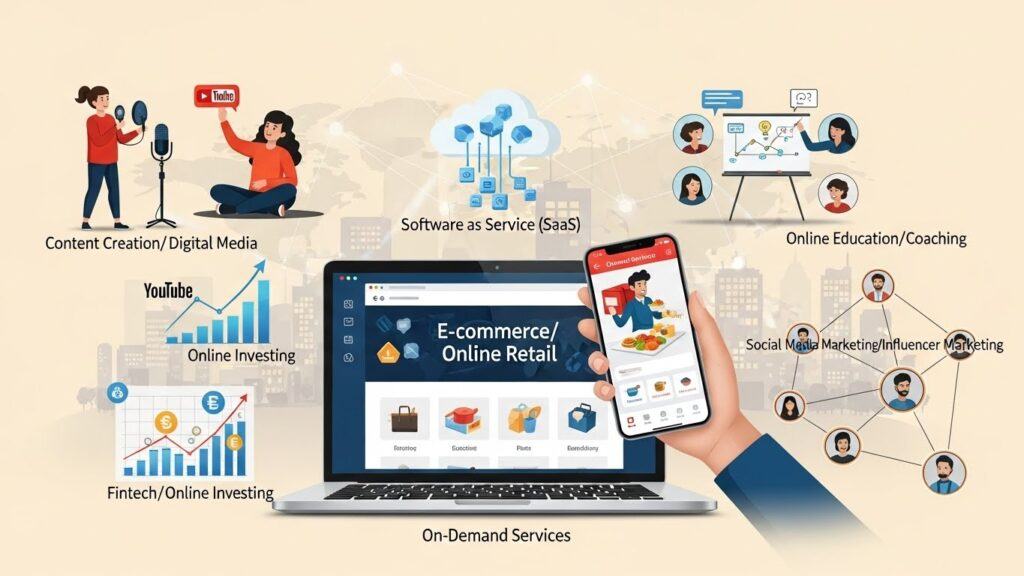
Here are some of the most popular—and proven—online business types:
Freelancing or Service-Based Businesses
Great for people with a skill to offer (writing, design, marketing, admin, coding).
Digital Products
Courses, ebooks, templates, printables, or software.
Best for people who enjoy teaching or creating scalable assets.
Content Creation
Blogging, YouTube, podcasting, or social media influence.
Ideal for people who enjoy storytelling, educating, or entertaining.
Ecommerce
Selling physical products, either through dropshipping, print-on-demand, or your own branded store.
Coaching and Consulting
Perfect for people who want to guide others using their expertise or experience.
Each model has different levels of time investment, scalability, and income potential.
5. Test Your Idea Before Committing
Before you fully commit:
- Create a small version of your offer (a mini-course, a low-cost product, a simple service)
- Get a few early users or clients
- Ask for feedback
- Improve based on what people actually want
This reduces risk and helps you build a business on real data—not guesswork.
6. Make Your Decision With Confidence
When choosing, consider these three questions:
- Does this idea align with my skills and interests?
- Is there a real market demand?
- Does it fit my lifestyle, resources, and long-term goals?
No idea will check every box perfectly, but the best one is the idea you feel excited to take action on—and capable of sustaining.
Conclusion
There is no “perfect” online business idea. There is only the idea that matches you: your strengths, your goals, and the people you want to serve.
Start small, learn as you go, and stay curious. The clarity (and success) grows in the process—not before it.
Achieve everything above all in one place